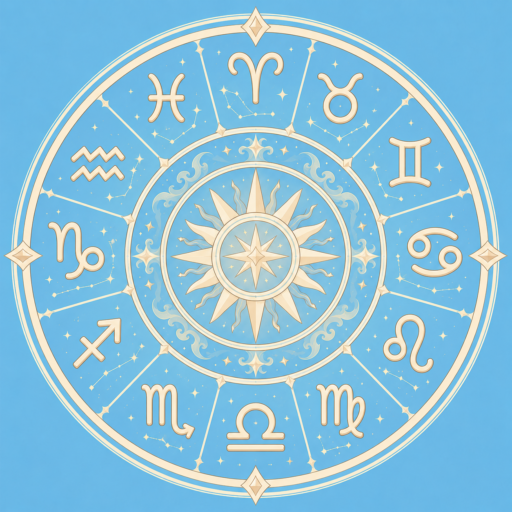
What A Compatibility Score Actually Measures
A compatibility score is not a forecast. It cannot be, because two birth dates contain no information about whether two people treat each other well, and that is what determines whether a relationship works.
What a score can describe is translation cost: how much conscious effort two temperaments have to spend to understand each other. That is a genuinely useful quantity, and it is not the same as quality.
Why Element Alone Is Not Enough
Most compatibility tools online score on element and stop. Fire with air is good, earth with water is good, everything else is friction. That produces five possible outcomes for 144 pairings, which means it is not really a calculation at all – it is a lookup table with extra presentation.
There is a deeper problem. In the zodiac, the angle between two signs determines their element relationship completely. Two signs four apart are always the same element. Two signs three apart always share a modality. Element, modality and polarity are not independent factors that can be weighed against each other; they are all restatements of the distance around the wheel.
So a tool that claims to weigh four factors is usually counting the same fact four times and presenting the result as a nuanced calculation.
What The Angle Actually Says
The aspect between two signs is the real structural relationship, and the tradition has a coherent account of each one.
The trine, four signs apart and the same element, is the smoothest angle. Understanding costs almost nothing. Its risk is stasis – with no friction anywhere, nothing forces either person to grow, and comfortable pairings can quietly stop developing.
The square, three signs apart, is the friction angle. Both signs share a modality, which means they want the same thing at the same moment and pursue it in incompatible ways. This generates more heat than any other pairing. Handled well it is the angle that makes both people better, because neither can coast.
The opposition, six signs apart, is magnetic and demanding. Each holds, fully developed, the quality the other has least of. The pull is real and so is the distance, and it does not get negotiated once.
The quincunx, five signs apart, shares no element, no modality and no polarity – the least structural common ground of any pairing. Nothing is automatic. In practice this is not a bad footing, because pairs who know from the start that they will have to translate usually do it.
The Factor That Varies Within An Angle
If aspect were the only input, every trine would score identically and the tool would be a seven-value lookup table. Something independent of the angle is needed, and rulership supplies it.
Leo and Sagittarius are both trines to Aries, but Sun with Mars and Jupiter with Mars are different relationships, and the tradition treats them differently. Ruling planets are not derivable from the distance between two signs, which is precisely what makes them useful as a second factor.
That is how the compatibility tool on this site is built: aspect carries most of the weight, rulership varies the result within each band, and the page shows you which angle produced your number so you can disagree with the reasoning rather than just the score.
The Pairings That Confound The Scores
Ask couples who have been together thirty years what their signs are and you will find a great many squares and oppositions. The angles that score badly are heavily represented among relationships that last, and there is a reasonable explanation for that.
Friction produces attention. Two people who cannot assume the other works the way they do are forced to actually ask, and asking is most of what a relationship needs. A pairing that requires no translation invites both people to stop paying attention, and inattention is a slower and more reliable killer than conflict.
So a low score is not a warning and a high one is not a promise. Read the score as a description of where the work will be, and then notice that every relationship has work somewhere.